From the Dance of Death to the Tower of Niguliste
From the Dance of Death to the Tower of Niguliste
Begin with the Dance of Death in St Anthony's Chapel
The work that asks for the most time at Niguliste Museum hangs in St Anthony's Chapel. The Dance of Death was painted on canvas in the late fifteenth century by the workshop of the Lübeck artist Bernt Notke. Its surviving opening fragment is 7.5 metres long, so it is easier to read the scene as a sequence than to take it in at once.
A preacher opens the image from a pulpit. Death appears with a bagpipe and a coffin, then the Pope leads the living figures, followed by the Emperor, Empress, Cardinal, and King. At the right edge, only a strip of the next figure's episcopal robe remains, a visible reminder that the procession once continued.
A painted band under the figures carries a verse dialogue between Death and the living in Low German. Looking down to the text after studying the faces and gestures helps connect each speaker to the image. The museum also presents the dialogue in several languages, although the schedule and format should be checked for the day of a visit.
What is known about the missing procession
The thirteen surviving figures form the beginning of a much larger composition. The museum estimates that the complete work, assembled from several sections, may have approached 30 metres. The identity of the later figures, the precise original length, the first location, and the commissioner remain unresolved.
The first written reference appears in a church warden's account book from 1603. Museum research suggests that the painting may have been commissioned for St Matthew's Chapel at the end of the fifteenth century. That chapel was enlarged between 1486 and 1493 and became known as St Anthony's Chapel in the seventeenth century.
Notke's workshop had completed another Dance of Death with 49 figures for St Mary's Church in Lübeck in 1463. Its condition led to the making of a copy in 1701, and that copy was lost in 1942. The Tallinn fragment, set against an autumn landscape with buildings from Lübeck, is identified by the museum as the only surviving medieval Dance of Death painted on canvas.
A parish church rebuilt as a museum
St Nicholas' Church was dedicated to the patron saint of merchants and seafarers and is believed to have been founded in the mid thirteenth century. It was one of medieval Tallinn's two parish churches and among the city's wealthier churches. A three-aisled nave, sacristy, and the lower part of the western tower were added by the end of that century.
Major rebuilding between 1405 and 1420 gave the chancel and nave much of their present form. The aisles and nave were raised, the building took on a basilican arrangement, and its chapels grew over time. By the early sixteenth century, more than twenty side altars stood inside, many connected to works commissioned by Tallinn's merchants and civic associations from northern European art centres.
War changed the interior decisively. Evacuation of valuable works began in 1943, but the bombing and fire of 9 March 1944 destroyed the pews, balconies, pulpit, and several epitaphs that remained. Reconstruction started in 1953, and in 1984 the restored building opened as a branch of the Art Museum of Estonia and as a concert hall.
Opening the wings of Hermen Rode's high altar retable
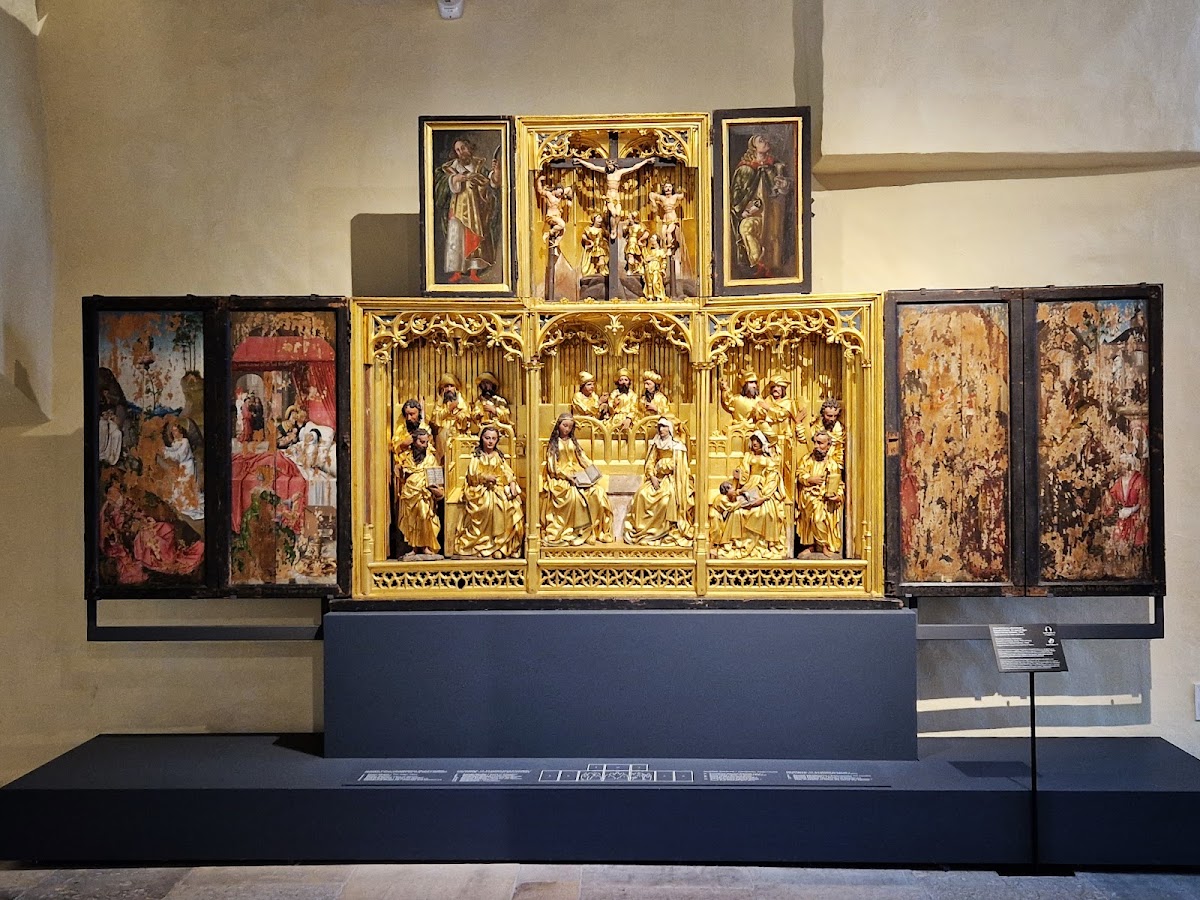
The high altar retable was commissioned from the Lübeck workshop of Hermen Rode and made between 1478 and 1481. Fully opened, it measures more than six metres across and almost 3.5 metres high. Two pairs of wings create a closed everyday view, a half-open view, and a fully open festive display.
The closed wings show the Virgin Mary, St Catherine of Alexandria, and St Barbara opposite St Nicholas, St Victor of Marseilles, and St George. Coats of arms for Tallinn's Great Guild and the Brotherhood of the Black Heads connect the object to its principal civic supporters. In the half-open position, episodes from the lives of St Nicholas and St Victor unfold across the painted panels.
The fully opened retable contains 33 large gilded and polychrome sculptures arranged in two rows. Christ blessing the crowned Virgin occupies the upper centre, while St Anne, the Virgin, and the Christ Child sit below. More than forty saints and biblical figures appear across the complete work, and beginning at the centre makes its hierarchy easier to follow.
The conservation history behind the gilded surface
Conservation of the retable has taken place in stages. In the 1970s it was sent to restoration centres in Russia, where pigment and binding media analysis accompanied treatment and partial infrared photography. The work stopped in the early 1990s around the restoration of Estonian independence, after the wings and roughly half of the large polychrome sculptures had been treated.
The Art Museum of Estonia returned to the unfinished work with the Rode Altarpiece in Close-Up project from 2013 to 2016. Photogrammetry, 3D scanning, near-infrared, ultraviolet and X-ray examinations, and raking-light photography documented the surface and internal construction. Dendrochronology and material analysis added evidence about the oak, pigments, varnishes, and adhesives used in the workshop.
Partners included the Estonian Academy of Arts, the Kanut Conservation and Digitisation Centre, the University of Tartu, and the University of Southampton. Their work links the retable in the gallery to samples, scans, and technical records produced elsewhere. On the object itself, differences in gilding, carved ornament, and painted surfaces give a practical sense of what the conservators had to examine.
Objects that still belong to the architecture
Niguliste's permanent display extends well beyond its major altarpieces. It includes sixteenth and seventeenth-century epitaphs and heraldic epitaphs, as well as sconces and chandeliers dating from the sixteenth to the eighteenth century. More than one hundred grave slabs and fragments are shown, many originating in St Nicholas' Church and dating from the fourteenth to the seventeenth century.
A seven-branched brass candelabrum donated in 1519 stands almost four metres high. Made in a Lübeck foundry, it remains large even within the tall nave. Moving close for the casting details and then stepping back to compare it with the church interior reveals the scale for which it was made.
Much of the Niguliste collection came from this church, and several works are displayed near their former locations. The building therefore supplies evidence about placement and use as well as shelter for the collection. Doorways, floor slabs, chapel entrances, and wall surfaces deserve attention beside the labels.
Silver from churches, guilds, and the Black Heads
The Silver Chamber occupies the former sacristy. Its display is divided among church silver, objects owned by the Brotherhood of the Black Heads, and silver from guilds and craft associations. Names first encountered on the high altar retable reappear here on cups, vessels, and ceremonial objects used by Tallinn's organised citizens.
The Black Heads collection ranges from the sixteenth to the twentieth century. Its oldest object is an early sixteenth-century popinjay with ruby eyes, once passed to the winner of a medieval archery contest. Standing cups, tankards, and beakers make up much of the group, including a deer-foot cup form found only in Tallinn.
Guild silver includes tall welcome cups from the seventeenth and eighteenth centuries, an alderman's mace, and a table bell. A craftsman who became a master traditionally donated a silver pendant shield bearing a name, date, and trade emblem. The shields were hung on welcome cups during ceremonies, which explains the holes and fittings visible on these small objects.
A glass lift inside the medieval tower
After nearly a year of reconstruction, the museum opened its historic tower to visitors on 11 March 2023. It was the first time the medieval tower became part of the regular visitor route. A glass lift rises through three floors to a skydeck with views across Tallinn Old Town and Tallinn Bay.
KOKO architects designed the architectural solution, lift, and skydeck, and OÜ Tarrest LT carried out the construction. Restored stairs provide another route between levels and reveal more of the tower's masonry. A display of church bells on the first floor covers examples from the medieval period to modern times.
The same project added a gallery on the second floor of the Small Chapel for medieval wooden sculpture and smaller retables. Its design uses surviving structural openings from congregation balconies destroyed during the Second World War. The addition allows both floors of the chapel to be used for the Art Museum of Estonia's medieval wooden sculpture collection.
How the new route changed access
The 2023 project also improved physical and sensory access. The lift connects all tower floors, guide paths were installed for visually impaired visitors, and a tactile floor plan helps with orientation. A large tactile model of St Nicholas' Church explains the relationship between the nave, chapels, and tower.
An Estonian audio description was prepared for the Dance of Death, and the dialogue painted beneath the figures has been translated into five languages. Services and operating details can change, so visitors who need a particular form of access should contact the museum in advance. The official access page also gives current information for wheelchair users planning to enter the galleries and tower.
A useful route begins in St Anthony's Chapel, continues to the high altar retable and Silver Chamber, then moves through the Small Chapel and up the tower. Canvas and silver at ground level give way to wooden sculpture, bells, and the city view above. The sequence also makes it easier to compare the building's former liturgical and memorial uses with its current exhibition route.
Planning the visit around Tallinn's seasons
Niguliste Museum stands at Niguliste 3, within walking distance of both Town Hall Square and Vabaduse väljak. Several bus and tram routes stop at Vabaduse väljak, while the Lühike jalg stairs descend from Toompea to the church. Parking inside Tallinn Old Town is subject to a fee, making arrival on foot or by public transport straightforward for many visitors.
The official schedule lists daily opening from 10:00 to 18:00 between May and September. From October through April the museum is closed on Mondays and open Tuesday through Sunday at the same times. Holidays, shortened days, special closures, and events can affect the route, so confirm both museum hours and tower access before setting out.
The current official online prices are 15 euros for adults, 10 euros for concession tickets, and 30 euros for families, with changes possible. Allow about 90 minutes to two hours for the permanent display and tower. From the skydeck, identifying the directions of the Old Town and Tallinn Bay gives a concrete measure of the height climbed from the ground-floor galleries.
Visit Info
- Address: Niguliste 3, 10130 Tallinn, Estonia
- Hours: The museum is open daily from 10:00 to 18:00 from May through September. From October through April it is closed on Mondays and open Tuesday through Sunday from 10:00 to 18:00. Holidays, events, and seasonal exhibitions can alter access, so check the official site on the day of your visit.
- Fee: The official online listing currently shows adult admission at 15 euros, concession admission at 10 euros, and a family ticket at 30 euros. Prices and eligibility may change. The official ticket page states that the Estonian Museum Card is not accepted at Niguliste Museum.
- Transport: The museum is a short walk along Harju Street from Town Hall Square or Vabaduse väljak. Many bus and tram services stop at Vabaduse väljak. Parking in Tallinn Old Town is subject to a fee.
- Time needed: Allow about 90 minutes to two hours for the permanent display and the tower. Lift operation and skydeck access can change with on-site conditions.
- Website: https://nigulistemuuseum.ekm.ee/en/
Visitor Info
| Address | Niguliste 3, 10130 Tallinn, Estonia |
| Hours | Translating |
| Admission | Translating |
| Getting There | Translating |
| Duration | Translating |
| Translating | https://nigulistemuuseum.ekm.ee/en/ |