Čiurlionis, Painted Music, and the National Museum in Kaunas
Čiurlionis, Painted Music, and the National Museum in Kaunas
Why painting and music meet in Kaunas
At the M. K. Čiurlionis National Museum of Art, music is more than a metaphor attached to painting. Mikalojus Konstantinas Čiurlionis trained as a composer before studying art and continued both practices at once. Paintings in the gallery and music in a separate hall allow their structures to be compared.
He was born in 1875 and died in 1911. His sustained work in painting and graphic art was concentrated between 1903 and 1909, yet he left more than 300 paintings, over 700 drawings and graphic works, and about 400 musical compositions. Almost all of this multimedia legacy is held in the museum, with some works elsewhere.
Calling him an early abstract artist is only a beginning. Mountains, seas, stars, towers, rulers, and invented landscapes remain visible even when the composition behaves like music. Repeated images and symbolic narratives keep the paintings from becoming pure exercises in nonobjective form.
A musician begins to paint
Čiurlionis was born in Varėna and grew up in Druskininkai. He studied at the orchestral school in Plungė from 1889 to 1893, continued at the Warsaw Institute of Music, and attended the Royal Conservatory in Leipzig in 1901 and 1902. Music occupied the longer part of his formal education.
He began drawing studies in Warsaw in 1902 and entered the new Warsaw School of Fine Arts in 1904. Composition, folk-song arrangement, performance, choral direction, and cultural writing continued beside art. One discipline did not simply replace the other.
He participated in the First Lithuanian Art Exhibition in Vilnius in 1907 and helped organize the second in 1908. He also wrote for the Lithuanian press and directed a choir. The museum grew from the wish to preserve work connected to both an individual career and a wider cultural movement.
Turning movements of a sonata into visual structure
The painted sonatas are not illustrations of particular pieces of music. Official research describes rhythm, repetition, contrast, layering, and large-scale composition moving from one medium to another. Works within a cycle carry movement names such as Allegro, Andante, Scherzo, and Finale.
Seven painted sonatas are identified: Sonata of the Sun and Sonata of the Spring from 1907; Sonata of the Serpent, Sonata of the Summer, Sonata of the Sea, and Sonata of the Stars from 1908; and Sonata of the Pyramids from 1909. Their descriptive subtitles became established alongside the artist’s numbered designations.
Follow recurring horizons, waves, stairs, suns, stars, and towers across a cycle rather than treating each panel in isolation. Differences in density and colour can produce something like changes of tempo. No musical training is required to observe how a form returns in altered scale or position.
From Creation of the World to Rex
Creation of the World, The Zodiac, and Rex address cosmic order through stacked spaces, remote horizons, and sources of light. A scene may begin like a landscape and then become an unfamiliar model because its proportions and repetitions refuse ordinary perspective.
Cycles such as Sparks and Winter organize natural forms into repeated visual units. The 1907 triptych My Road moves away from conventional representation through its linear rhythm and helps explain the later sonatas. The development is easier to see across groups than through one famous image.
Late works from 1909 include Rex, Castle Fairy Tale, The Altar, and Lithuanian Graveyard. They retain symbols and story even when their structure appears abstract. Reading the career only as progress toward pure abstraction would remove much of what the paintings continue to depict.
A museum founded in 1921 to preserve a legacy
The official founding date is 14 December 1921, ten years after the artist’s death. Paulius Galaunė, an artist and museum specialist, took charge of the Čiurlionis Gallery in 1924. Its temporary home opened on 13 December 1925 with about 4,500 objects.
A new building opened to the public in 1936 and first carried the name of Grand Duke Vytautas the Great. The institution expanded into Lithuanian art and folk culture, received national status in 1997, and has displayed Čiurlionis paintings and graphic work in renovated rooms since 2003.
This chronology explains how a memorial purpose became a national collection. Visitors who leave after the artist’s rooms understand the point of origin but not the present scope. Historical art, folk art, and the exhibition on Lithuania as a land of crosses complete the institutional picture.
A museum within modernist Kaunas
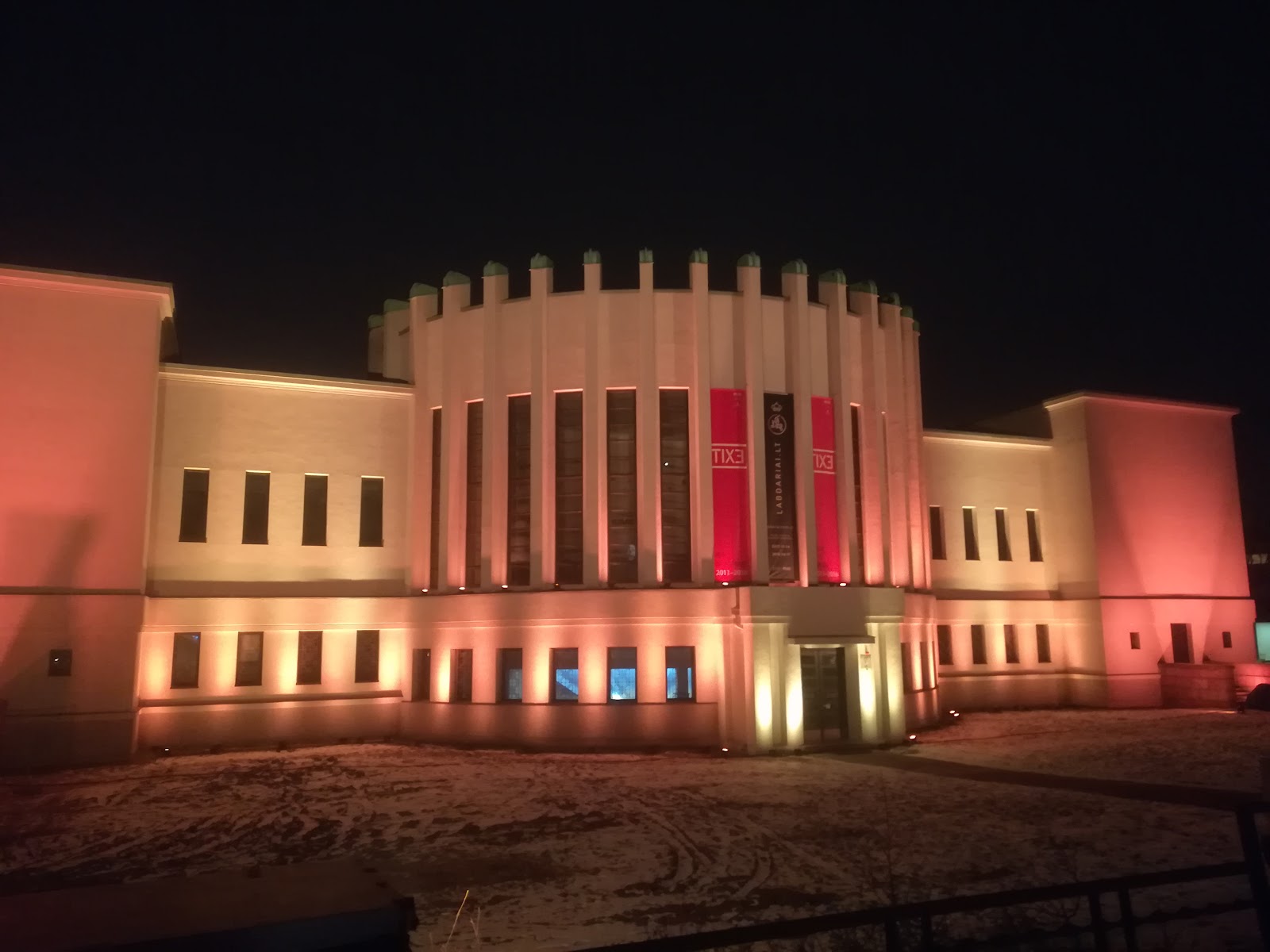
The building belongs to the interwar architecture of Kaunas. UNESCO inscribed Modernist Kaunas: Architecture of Optimism, 1919-1939 on the World Heritage List in 2023. Public buildings, housing, and streets record the years when the city rapidly developed national institutions.
The architecture is later than the art at the centre of the museum. Keeping those dates separate prevents a convenient but false merger of periods. Early twentieth-century paintings occupy a building shaped by the political and civic programme of the 1920s and 1930s.
Entrance, stair, window bands, and gallery axes reveal expectations for a public museum rather than a converted home. Looking at the exterior before entering helps place the collection within the urban history of Kaunas.
Music Hall and the longer history of Lithuanian art
Visit the Music Hall after studying the paintings. Memory of a recurring visual motif changes the way a composition is heard, while differences between sound and image remain clear. The comparison supports the idea of shared principles without pretending that every picture translates a score.
The display of Lithuanian art from the fourteenth to nineteenth centuries broadens the chronology. Coins, jewellery, rare books, and early sculpture lead to Gothic Madonnas and church art, followed by aristocratic interiors, dress, tapestry, and portraiture.
Folk art and the culture of crosses provide another setting for the symbols in Čiurlionis. Direct influence should not be claimed for every form. The displays instead establish a visual vocabulary against which his transformations can be judged more carefully.
Planning between two and three hours
The visitor entrance is at V. Putvinskio g. 55. The official schedule lists Tuesday, Friday, Saturday, and Sunday from 10:00 to 18:00, and Wednesday and Thursday from 11:00 to 19:00. Entry closes at least thirty minutes before the museum.
Current listed admission is 10 euros, with a reduced price of 5 euros and free general entry on the last Sunday of each month. Audio guides and advance-booked tours have separate conditions. Check the official ticket page for changes.
Two hours is reasonable for the Čiurlionis display and Music Hall. The other permanent exhibitions can extend a visit beyond three hours. Returning to one sonata at the end often reveals a repetition missed on the first circuit.
Visit Info
- Address: V. Putvinskio g. 55, Kaunas, Lithuania
- Hours: Tuesday, Friday, Saturday, and Sunday 10:00-18:00; Wednesday and Thursday 11:00-19:00. Last entry is at least 30 minutes before closing
- Fee: General admission €10 and reduced admission €5. General entry is free on the last Sunday of each month. Confirm current conditions
- Transport: Walk or use local public transport from central Kaunas
- Time needed: Allow about two hours for Čiurlionis and the Music Hall, or three hours and more with the other permanent displays
- Website: https://ciurlionis.lt/
Visitor Info
| Address | V. Putvinskio g. 55, Kaunas, Lithuania |
| Hours | Translating |
| Admission | Translating |
| Getting There | Translating |
| Duration | Translating |
| Translating | https://ciurlionis.lt/ |