Museum Puri Lukisan and the Making of Modern Ubud Painting
Museum Puri Lukisan and the Making of Modern Ubud Painting
Galleries distributed through a garden
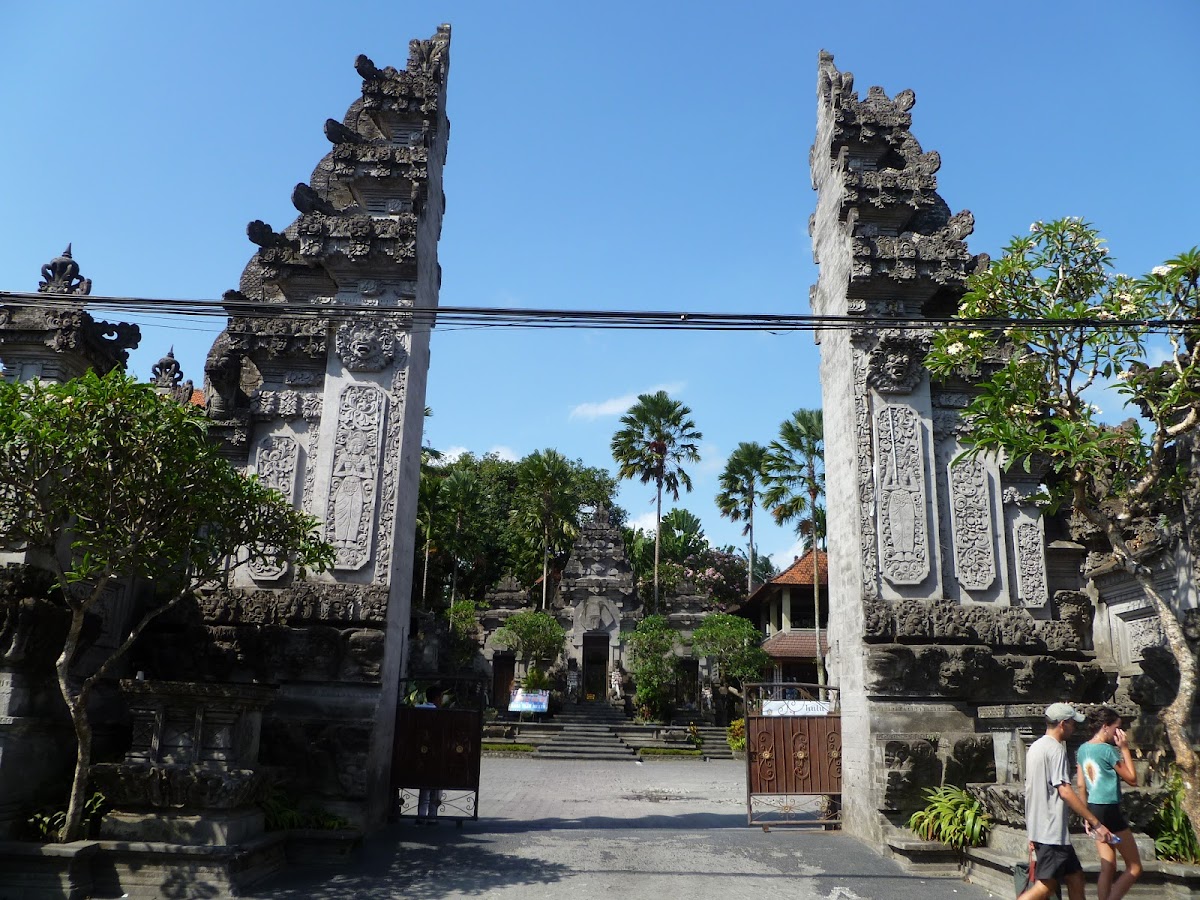
Museum Puri Lukisan begins beyond a split gate on Jalan Raya Ubud. East, west, and north gallery buildings, the Sukawati Gallery, shared pavilions, ponds, bridges, and paths are distributed through an enclosed garden. Outdoor intervals separate groups of paintings.
The arrangement slows a chronological reading. Visitors leave one room, cross water or shade, and reconsider figures, ceremonies, fields, and village scenes under the actual light of Ubud. The garden is not documented as a single symbolic artwork, but it clearly regulates attention between displays.
Older and newer styles should not be divided too neatly. Religious narrative, ritual, everyday life, perspective, anatomy, and changes in colour coexist in different proportions. The museum’s institutional history helps prevent the art from being described either as an untouched tradition or as an imported invention.
The weekly meetings of Pita Maha from 1936
Rudolf Bonnet formed Pita Maha in 1936 with members of the Ubud royal family, including Tjokorda Gde Agung Sukawati and Tjokorda Gde Raka Sukawati. Bali government records also name Walter Spies and I Gusti Nyoman Lempad among the founders.
The museum states that about 125 members were introduced through exhibitions abroad. Painters and woodcarvers met weekly to present and evaluate work. Selection joined criticism to exhibition and sale, placing individual production before a regular group of peers and patrons.
The meetings were not simply a school where Europeans supplied new methods. Artists brought established imagery and workshop knowledge, then tested different spatial and bodily conventions. Members came from Ubud, Pengosekan, Peliatan, Tebasaya, and other villages, and practices circulated through local networks.
Everyday life enters established narratives
One visible change in Pita Maha painting is the expanded range of subjects. Wayang and religious stories continued, while temple ceremonies, dance, agricultural labour, markets, and village life appeared more frequently. Mythic and everyday figures could share the same patient linear detail.
Studies identify changes in proportion, anatomy, perspective, light, shadow, and colour. These devices entered dense Balinese compositions without producing a single standard style. Works from the same period differ in the size of figures, depth of landscape, empty space, and tonal range.
The phrase that European artists modernised Balinese painting reduces this process too far. Bonnet and Spies mattered, but so did royal patronage, criticism among Balinese artists, and village workshops. Encounters supplied options; local artists decided how those options entered their work.
War redirects the project toward a museum
The Second World War ended the regular activity of Pita Maha. Research dates its last exhibition to Surabaya on 3 December 1941, and Bonnet’s imprisonment by Japanese forces in 1942 made continuation impossible. A later Ubud Painters Group did not last.
Concern that major Balinese works were leaving the island had existed before the war. The Ratna Wartha Foundation was established in 1953 to continue the association’s aims in a durable form. Plans also developed for a museum of modern Balinese art designed by Bonnet.
Museum Puri Lukisan opened on 31 January 1956, with Education and Culture Minister Mohammad Yamin at the inauguration. Tjokorda Gde Agung Sukawati and Rudolf Bonnet were central to the project. Weekly criticism and external exhibition had become collection, preservation, and permanent public access.
From Kamasan to Pita Maha and Ubud painting
The official collection material uses broad categories before and after the war. Scholarship describes Bonnet’s holdings as an important base and identifies a route from Kamasan traditions to Pita Maha and Ubud painting. Current room-by-room lists are limited, so individual works should not be assumed to remain on permanent display.
Official material names artists such as Ida Bagus Made, I Dewa Sobrat, I Dewa Putu Bedil, I Gusti Ketut Kobot, Dewa Putu Mokoh, and I Gusti Nyoman Lempad. Comparing line, scale, background depth, and the treatment of similar subjects is more useful than memorising the list.
A 2008 study counted 227 paintings and 105 sculptures, but those numbers describe that survey rather than the current inventory. Safe collection categories include Kamasan, Pita Maha and Ubud work, postwar and contemporary Ubud painting, and sculpture.
Tourism and workshops alter production
Postwar change also involved the market. The 1963 eruption of Mount Agung and political violence in 1965 contributed to economic hardship. Mass tourism expanded in the early 1970s, bringing more buyers into contact with village painters and changing the roles of galleries, shops, workshops, and museums.
The Young Artist style developed in Penestanan under Arie Smit. Its bright colour and scenes of daily life became familiar to visitors, but it is only one part of the period. Village affiliation, workshop relations, size, materials, criticism, and routes of sale all influenced production.
The museum did not stand outside these conditions as a pure store of tradition. It kept works on the island and proposed a history while Ubud became a centre of cultural tourism. What entered the collection and whose names remained visible were connected to systems of exhibition and exchange.
Walking from the East Building to Sukawati Gallery
The official site plan places the security post and stages near the entrance, with ticketing to the east. The East Building, Wantilan, North Building, West Building, and Sukawati Gallery follow around the garden. No compulsory one-way route is stated.
Beginning in the East Building, crossing toward the north and west galleries, and ending at Sukawati Gallery reduces backtracking. Pond bridges and shade provide natural pauses. Toilets are marked in the northwest and east, while a restaurant and bale bengong stand near ticketing.
In each building, compare the relation between people and setting. Dense crowds, open rice fields, ceremonial processions, markets, and labour scenes reveal formal change more clearly than a style label alone. Sculpture adds evidence about volume and the body during related periods.
Allowing two hours in central Ubud
The museum is about 300 metres west of Ubud Palace and Ubud Market, on the north side of Jalan Raya Ubud. A large wooden sign and split gate identify the entrance. The central location is convenient, but the distributed galleries reward ninety minutes to two hours.
The latest official web listing gives daily hours of 09:00 to 18:00 and adult admission of Rp95,000. Children under fifteen accompanied by an adult are listed as free, while group rules differ. Check current hours, prices, and tours before arrival.
End by looking across the garden toward the first gallery. Pita Maha’s weekly criticism in 1936, the Ratna Wartha Foundation in 1953, and the museum opening in 1956 form a continuous institutional history. The organization of artists is as important here as the paintings on the walls.
Visit Info
- Address: Jalan Raya Ubud, Gianyar 80571, Bali, Indonesia
- Hours: The latest official web listing states daily opening from 09:00 to 18:00. Confirm on the day of travel
- Fee: The latest official web listing states Rp95,000 for adults and free entry for accompanied children under 15. Group conditions differ
- Transport: About 300 metres west of Ubud Palace and Ubud Market, on the north side of Jalan Raya Ubud
- Time needed: Allow about 90 minutes to two hours for the galleries and garden
- Website: https://purilukisanmuseum.com/
Visitor Info
| Address | Jalan Raya Ubud, Gianyar 80571, Bali, Indonesia |
| Hours | Translating |
| Admission | Translating |
| Getting There | Translating |
| Duration | Translating |
| Translating | https://purilukisanmuseum.com/ |