Twentieth-Century Italian Art in the Boschi Di Stefano Apartment
Twentieth-Century Italian Art in the Boschi Di Stefano Apartment
A museum beyond an apartment entrance
Casa Museo Boschi Di Stefano occupies a residential building at Via Giorgio Jan 15 in Milan. The street presents an early twentieth-century apartment entrance rather than a detached museum facade. Upstairs, paintings fill corridors, sitting rooms, dining space, and studies.
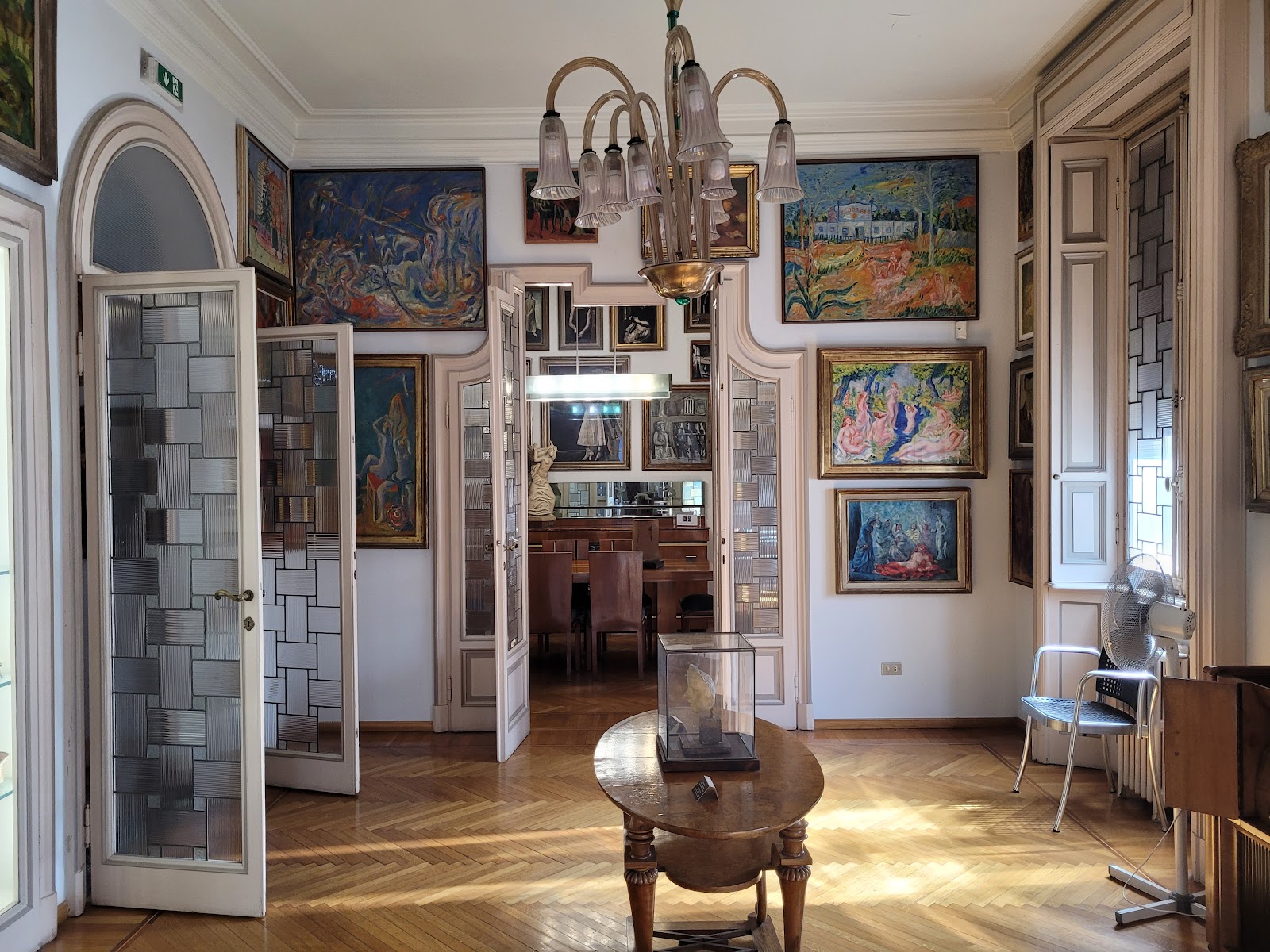
Works are not isolated on broad white walls. Doors, windows, furniture, and ceiling details press close to pictures of different sizes. Opposite walls often enter the same field of view. This density preserves something of the conditions under which collectors lived with art.
Begin by identifying the former purpose of each room. A dining area, study, and reception room establish different scales around the same picture. Public access has changed the apartment, but its plan still directs the visit.
Antonio Boschi and Marieda Di Stefano
The museum takes its name from Antonio Boschi, who lived from 1896 to 1988, and Marieda Di Stefano, who lived from 1901 to 1968. They continued buying art until the collection exceeded two thousand works despite the ordinary limits of a home.
Paintings are joined by sculpture and drawing, covering Italian art from the early twentieth century through the 1960s. The holdings do not form a complete retrospective of one artist or a single movement. They record repeated choices made within the couple’s own lifetime.
The apartment keeps those preferences visible. Multiple works by one artist, a drawing beside a major painting, and unexpected neighbours on the same wall reveal the collectors’ decisions more directly than a fully neutral chronological display.
A Piero Portaluppi building from 1929 to 1931
Piero Portaluppi designed the building for the Radici-Di Stefano company, and it was constructed between 1929 and 1931. Corner bow windows and marble details identify it from the street. The design belongs to a Milanese moment when modern planning and decorative finish continued to coexist.
Inside, domestic dimensions matter more than urban monumentality. Short corridors, connected sitting rooms, and light from the corner windows affect the size and placement of art. The architecture was never an empty container waiting for a collection.
Views back to the street place collecting within a living city of galleries, studios, work, and travel. The address is not a neutral wrapper. It is the location where the Boschi Di Stefano collection accumulated and where many choices were tested in daily life.
About 300 works selected from more than 2,000
The historic collection was donated to the Municipality of Milan in 1974. More than two thousand works belong to the full gift, while about three hundred are shown in the former apartment. The public display is therefore a selection, not the whole collection.
Three hundred objects create substantial density in a small home. Pictures hang in tiers and occupy walls around furniture, allowing artists of the same decades to be compared at close range. Differences in colour, figure, city, still life, and handling become more immediate than a textbook sequence.
Trying to read every label in order can flatten the experience. First examine a complete wall, choose two or three works for closer attention, then step back to the arrangement. Drawings and small sculpture deserve a separate scan below eye level and near furniture.
Mario Sironi and a room devoted to painting
The municipal audio tour identifies room five with Mario Sironi. Several works allow figures, architectural forms, and dark masses to be compared across one artist’s practice. The concentration records the collectors’ sustained attention rather than a single celebrated purchase.
Room six is introduced as the pleasure of painting and names Corrente, Filippo de Pisis, and Giorgio Morandi. Still life, landscape, brushwork, and colour differ sharply even within broadly related decades. Close placement makes those differences physically easy to test.
Room titles are starting points, not verdicts. Sironi changes from work to work, and still lifes by Morandi and de Pisis should not be judged through one formula. Tonal weight, spacing between objects, and the depth of a background offer more precise comparisons.
From the 1974 donation to the 2003 opening
The collection entered municipal ownership in 1974, but the apartment did not immediately open as a museum. Registration, conservation, selection, safety, and circulation required preparation. Casa Museo Boschi Di Stefano welcomed the public in 2003, almost thirty years after the gift.
The city could have moved the works into conventional galleries. Opening the former home instead retained the connection between collection and daily space. Doors, windows, furniture, and room-to-room distances make the scale of the couple’s commitment visible.
A public museum inside a home also creates conservation pressure. Many visitors pass through narrow rooms, daylight affects surfaces, and furniture and architectural detail require care beside the artworks. Limited opening patterns and visitor rules support that work.
Reading the rooms before individual works
Start with a complete wall near the entrance, then move clockwise. This simple route reduces backtracking in the tight plan. Thresholds frame two rooms at once, allowing the colours and densities of neighbouring groups to be compared.
Look for repetition in a room concentrated on one artist and for difference where several artists share a wall. Sculpture changes height and empty space among paintings. Drawings require a closer view, best taken without blocking the narrow route for others.
Return to windows and furniture before leaving. Imagining the apartment without art clarifies the extraordinary density of the collection, while imagining the works without the rooms removes evidence of how they were lived with. Each record gives scale to the other.
Free admission and a compact visit
The official address is Via Giorgio Jan 15, a short walk from Lima station on Milan Metro line M1. Because the museum shares the entrance of a residential building, the street number and current access instructions are more useful than searching for a monumental sign.
Municipal and foundation information currently lists opening from Tuesday through Sunday, 10:00 to 17:30, with last entry at 17:00 and free admission. The museum closes on Monday, 1 January, 1 May, and 25 December. Check the official page for special openings or events.
An hour to ninety minutes is enough for a considered circuit if a few rooms and artists receive deeper attention. After leaving, find the corner bow windows from the street. Their direction reconnects the light inside the apartment to Portaluppi’s exterior.
Visit Info
- Address: Via Giorgio Jan 15, 20129 Milan, Italy
- Hours: Tuesday to Sunday, 10:00-17:30, with last entry at 17:00. Closed Monday, 1 January, 1 May, and 25 December
- Fee: Free admission. Check official information for special programmes and any reservation conditions
- Transport: A short walk from Lima station on Milan Metro line M1
- Time needed: Allow about one to ninety minutes for the apartment
- Website: https://www.casamuseoboschidistefano.it/
Visitor Info
| Address | Via Giorgio Jan 15, 20129 Milano, Italy |
| Hours | Translating |
| Admission | Translating |
| Getting There | Translating |
| Duration | Translating |
| Translating | https://www.casamuseoboschidistefano.it/ |